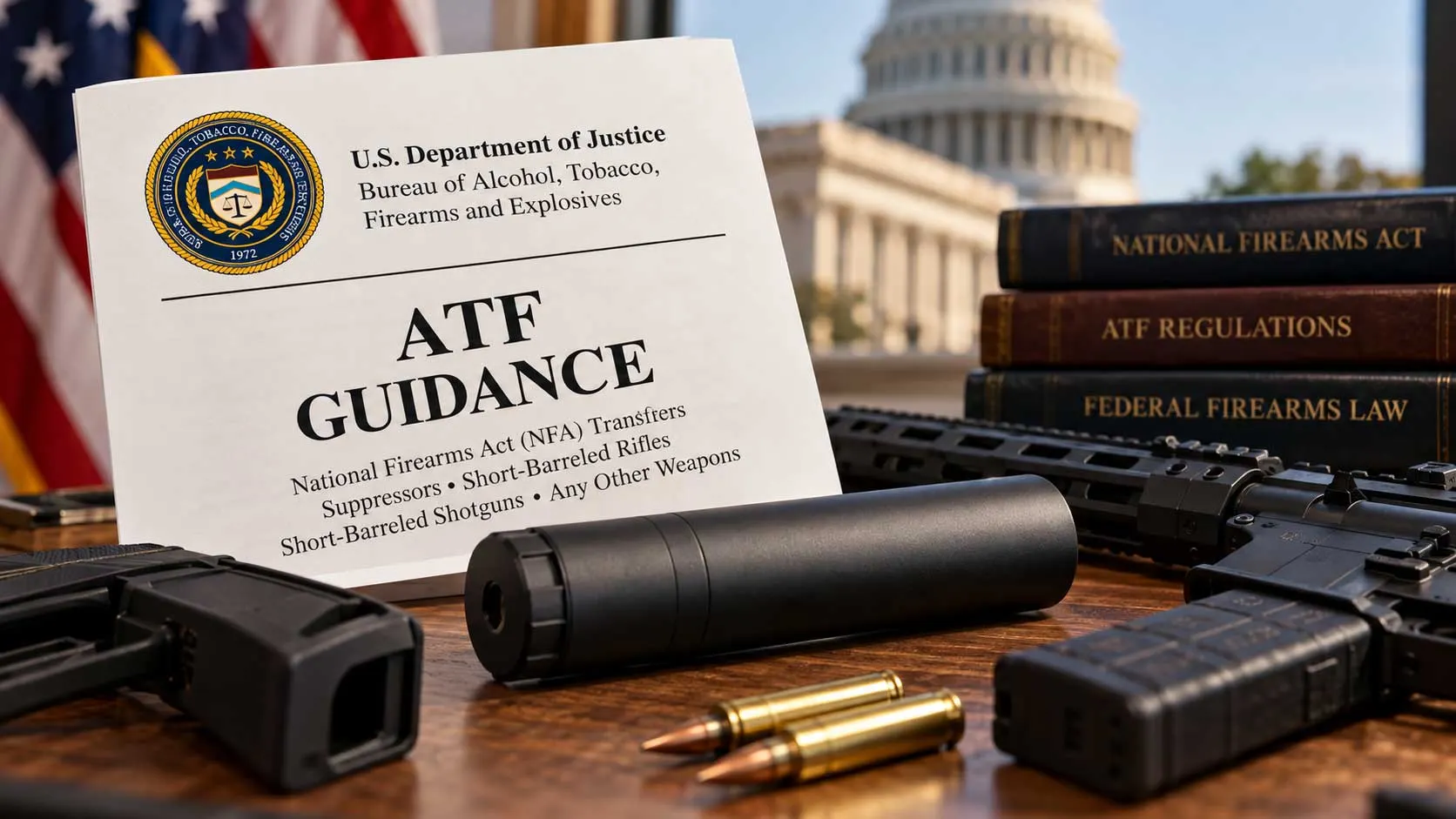
The Bureau of Alcohol, Tobacco, Firearms and Explosives recently issued new guidance regarding certain National Firearms Act items, including suppressors, short-barreled rifles, short-barreled shotguns, and “any other weapons.”
This is a major development for firearm owners, firearm retailers, and anyone who has been following the changing legal landscape around ATF Form 4 transfers and NFA-regulated items.
The short version: ATF has announced that it will no longer enforce certain NFA approval, registration, tax-stamp, and transfer requirements for specific items that are no longer subject to a federal making or transfer tax. However, that does not mean these items are completely unregulated. Federal Gun Control Act requirements, background checks, dealer recordkeeping, state law, and certain interstate-transport rules still matter.
This article is for general information only and should not be treated as legal advice. Firearm laws can change quickly, and customers or dealers with specific questions should consult qualified legal counsel or the appropriate authorities.
What Did ATF Announce?
According to ATF’s October 2026 guidance, the agency will not enforce the requirement for individuals to apply for and receive ATF approval before making or transferring certain NFA items. The covered items include:
- Suppressors, also commonly called silencers
- Short-barreled rifles
- Short-barreled shotguns
- Certain “any other weapons,” often called AOWs
ATF also stated that it will not enforce the NFA registration, tax-stamp, or related requirements for those covered items.
This is a significant change from the traditional process, where a customer buying a suppressor or short-barreled rifle generally had to submit the appropriate NFA paperwork, wait for ATF approval, and receive an approved Form 4 before taking possession.
Does This Mean Form 4 Is Gone?
For the covered items listed above, ATF says it will not require prior approval under the NFA before making or transferring those items. That affects the traditional Form 1 and Form 4 process for covered suppressors, short-barreled rifles, short-barreled shotguns, and AOWs.
However, ATF also says it will continue to process NFA forms voluntarily. Some individuals may still choose to submit forms if they want the item registered in the National Firearms Registration and Transfer Record.
This is important because the current situation involves enforcement discretion and a court ruling. It is not the same thing as Congress fully repealing the NFA. Future court decisions, federal guidance, or legislative changes could affect how this plays out.
What Does This Mean for Suppressors and Silencers?
For suppressors, this could be one of the biggest federal-level changes in decades. Historically, suppressor buyers had to complete the NFA transfer process before taking possession. Under ATF’s new guidance, ATF says it will not enforce the NFA approval, registration, or tax-stamp requirements for covered suppressors.
That may make suppressors more accessible to lawful buyers, but it does not remove all legal requirements. A suppressor is still considered a firearm under federal law. If purchased through a licensed dealer, the buyer still needs to complete a Form 4473 and pass the required background check unless an exemption applies.
For customers, that means suppressors may now be handled more like standard firearm purchases at the federal level, but buyers still need to comply with all federal, state, and local laws.
What About Short-Barreled Rifles and Collapsing Stocks?
Short-barreled rifles are also included in ATF’s new guidance.
A collapsing stock by itself is not automatically an NFA item. The issue usually comes down to the configuration of the firearm. If a firearm has a rifle stock and a barrel shorter than the legal rifle minimum, it may be considered a short-barreled rifle depending on the overall configuration.
Under ATF’s new guidance, the agency says it will not enforce certain NFA making, transfer, registration, and tax-stamp requirements for short-barreled rifles. However, short-barreled rifles still remain subject to other federal rules under the Gun Control Act. ATF also notes that individuals still need to file a Form 20 before transporting a short-barreled rifle or short-barreled shotgun across state lines.
So, while the NFA side of the process has changed dramatically, firearm owners should still be careful before modifying a firearm, adding a stock, changing barrel length, or traveling across state lines with a short-barreled rifle.
What This Means for Firearms Retailers
For firearm retailers and FFLs, the new guidance creates both opportunity and responsibility.
ATF says FFLs should process transactions involving covered items as they would other firearms under the Gun Control Act. That means dealers still need to:
- Complete ATF Form 4473
- Run the required NICS background check unless an exemption applies
- Keep required acquisition and disposition records
- Follow all Gun Control Act requirements
- Comply with state and local law
- Avoid selling or transferring to prohibited persons
Retailers should also be aware that some business activities still carry additional requirements. ATF says those engaged in the business of manufacturing, importing, or dealing in these firearms must still pay applicable special occupational taxes. Manufacturers may also have licensing, serialization, marking, and other compliance obligations.
For dealers, the biggest takeaway is that NFA non-enforcement does not mean “no paperwork” or “no compliance.” The normal firearm transfer rules still apply.
What This Means for the Public in Texas
For Texas gun owners, this guidance is especially relevant because the underlying court case came out of the Northern District of Texas, and Texas has already had a strong public conversation around suppressor regulation.
In general, Texas law has become more favorable toward suppressors in recent years. Texas also passed legislation addressing firearm suppressors manufactured in Texas and kept in Texas. However, state law and federal law are not always identical, and customers should not assume that every item or every configuration is automatically lawful in every circumstance.
For most lawful Texas buyers working with a licensed dealer, the practical change may be that some items that previously required NFA approval may now be transferable through the regular firearm-purchase process, including Form 4473 and a background check.
But there are still important cautions:
- Machine guns and destructive devices are not included in the same relief.
- Prohibited persons still cannot possess firearms.
- Dealers must still follow federal dealer requirements.
- State and local law still matter.
- Interstate transport rules may still apply to short-barreled rifles and short-barreled shotguns.
- Future legal changes are possible.
What Should Customers Do Now?
If you are interested in a suppressor, short-barreled rifle, or other covered item, the best first step is to talk with a knowledgeable local firearms retailer who is following the latest ATF guidance.
Customers should ask:
- Is this item covered by the new guidance?
- Does this transfer still require Form 4473 and a background check?
- Are there any Texas-specific concerns?
- Does this item involve interstate transport?
- Are there any remaining federal requirements that apply?
- Is voluntary registration something I should discuss with an attorney?
Because this area is changing quickly, it is wise to slow down, ask questions, and make sure each transaction is handled correctly.
County Armory Is Here to Help
At County Armory in Greenville, Texas, we are watching these developments closely so we can help customers understand what has changed and what requirements still apply.
Whether you are interested in suppressors, firearm transfers, custom rifle builds, gunsmithing, or general firearm sales, our goal is to help you navigate the process responsibly and professionally.
The recent ATF guidance represents a major shift in how certain NFA items may be handled, but responsible firearm ownership still means staying informed, following the law, and working with people who understand the process.
Update: For a closer look at what still applies after the tax stamp went to $0, including Texas suppressor law, SBR configurations and registered items, read The $200 Tax Stamp Is Gone — But Is the NFA Really Gone? What Texas Gun Owners Need to Know.
If you have questions about suppressors, transfers, short-barreled rifles, or other firearm services, contact County Armory or stop by our Greenville, Texas location.
County Armory — Quality Firearms. Expert Service. Trusted Local.
References
- ATF. “ATF Issues Guidance on National Firearms Act Transfers for Short-Barreled Rifles, Short-Barreled Shotguns, Suppressors and Certain Other Firearms.” Read the ATF press release
- ATF. “Update to NFA Transfer Guidance.” Read the ATF guidance
- ATF. “Firearms Open Letters.” View ATF firearms open letters
- Associated Press. “Justice Department moves to allow more people to purchase suppressors, short-barreled rifles and certain other firearms without federal registration.” Read the AP article
- Office of the Texas Governor. “Governor Abbott Signs Second Amendment Legislation Into Law.” Read the Texas Governor’s Office release